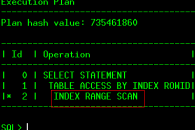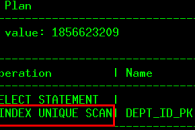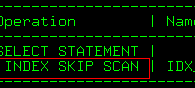
在前面的两篇中,分别描述了Index Unique Scan和Index Range Scan,今天来描述Index Skip Scan。
所谓的Index Skip Scan就是指,查询的WHERE条件中“SKIP”【跳过,没带上】了复合索引的前导列,只是指定了复合索引的其它列,这样CBO选择Index Skip Scan的路径来访问数据的方式。
如果复合索引的前导列唯一值越少(选择性低),非前导列索引唯一值越多(选择性高),则Index Skip Scan的性能越优。
事实上,在处理的过程中,Oracle将该复合索引上分为若干个logical subindexes(逻辑子索引),逻辑子索引的具体个数取决于前导列的唯一值值个数,即前导列有几个重复值就分为几个逻辑子索引。
Index Skip Scan适用的场景:
1 Index一定是一个复合索引(索引类型可以是UNIQUE的唯一索引,也可以是NONUIQUE的非唯一索引);
2 且复合索引的前导列重复值很多(即唯一值少),非前导列的重复值很少(唯一值多);
3 WHERE限制条件中,并没有带上该符合索引的前导列,仅仅是使用非前导列来过滤数据;
测试与验证:
1 创建测试表:
SQL> conn hr/hr
Connected.
SQL> create table skip_t as select object_id,object_name,object_type from all_objects;

Table created.

SQL> select count(*) from skip_t;

  COUNT(*)
----------
     55683

SQL> select count(distinct object_type) from skip_t;

COUNT(DISTINCTOBJECT_TYPE)
--------------------------
                        25

SQL> select count(distinct object_id) from skip_t;

COUNT(DISTINCTOBJECT_ID)
------------------------
                   55683

SQL> select count(distinct object_name) from skip_t;

COUNT(DISTINCTOBJECT_NAME)
--------------------------
                     30902

SQL>
从上,看到skip_t表数据情况:有55683条记录,且OBJECT_ID字段均唯一,无重复值。OBJECT_TYPE唯一值只有25个。
2 接下来,在OBJECT_TYPE和OBJECT_ID字段上创建复合索引,并收集统计信息:
SQL> create index idx_skip_t on skip_t(object_type,object_id);

Index created.

SQL> exec dbms_stats.gather_table_stats(ownname=>user,tabname=>'skip_t',cascade=>true);

PL/SQL procedure successfully completed.

SQL>
3 “Skip”掉复合索引前导列的情况,即让CBO按照预期的选择Index Skip Scan的路径来访问数据:
SQL> set autotrace trace
SQL> select object_type,object_id from skip_t where object_id=30000;

Execution Plan
----------------------------------------------------------
Plan hash value: 2119292092

-------------------------------------------------------------------------------
| Id  | Operation        | Name       | Rows  | Bytes | Cost (%CPU)| Time     |
-------------------------------------------------------------------------------
|   0 | SELECT STATEMENT |            |     1 |    15 |    26   (0)| 00:00:01 |
|*  1 |  INDEX SKIP SCAN | IDX_SKIP_T |     1 |    15 |    26   (0)| 00:00:01 |
-------------------------------------------------------------------------------

Predicate Information (identified by operation id):
---------------------------------------------------

   1 - access("OBJECT_ID"=30000)
       filter("OBJECT_ID"=30000)

Statistics
----------------------------------------------------------
          1  recursive calls
          0  db block gets
         14  consistent gets
          0  physical reads
          0  redo size
        611  bytes sent via SQL*Net to client
        524  bytes received via SQL*Net from client
          2  SQL*Net roundtrips to/from client
          0  sorts (memory)
          0  sorts (disk)
          1  rows processed

SQL> select object_type,object_name from skip_t where object_id=30000;

Execution Plan
----------------------------------------------------------
Plan hash value: 1237951313

------------------------------------------------------------------------------------------
| Id  | Operation                   | Name       | Rows  | Bytes | Cost (%CPU)| Time     |
------------------------------------------------------------------------------------------
|   0 | SELECT STATEMENT            |            |     1 |    40 |    27   (0)| 00:00:01 |
|   1 |  TABLE ACCESS BY INDEX ROWID| SKIP_T     |     1 |    40 |    27   (0)| 00:00:01 |
|*  2 |   INDEX SKIP SCAN           | IDX_SKIP_T |     1 |       |    26   (0)| 00:00:01 |
------------------------------------------------------------------------------------------

Predicate Information (identified by operation id):
---------------------------------------------------

   2 - access("OBJECT_ID"=30000)
       filter("OBJECT_ID"=30000)

Statistics
----------------------------------------------------------
          0  recursive calls
          0  db block gets
         15  consistent gets
          0  physical reads
          0  redo size
        640  bytes sent via SQL*Net to client
        524  bytes received via SQL*Net from client
          2  SQL*Net roundtrips to/from client
          0  sorts (memory)
          0  sorts (disk)
          1  rows processed

SQL>
4 使用索引前导列的情况:
SQL> select object_type,object_id from skip_t where object_type='TABLE';

136 rows selected.

Execution Plan
----------------------------------------------------------
Plan hash value: 3840590361

-------------------------------------------------------------------------------
| Id  | Operation        | Name       | Rows  | Bytes | Cost (%CPU)| Time     |
-------------------------------------------------------------------------------
|   0 | SELECT STATEMENT |            |  2227 | 33405 |     9   (0)| 00:00:01 |
|*  1 |  INDEX RANGE SCAN| IDX_SKIP_T |  2227 | 33405 |     9   (0)| 00:00:01 |
-------------------------------------------------------------------------------

Predicate Information (identified by operation id):
---------------------------------------------------

   1 - access("OBJECT_TYPE"='TABLE')

Statistics
----------------------------------------------------------
          1  recursive calls
          0  db block gets
         12  consistent gets
          0  physical reads
          0  redo size
       3592  bytes sent via SQL*Net to client
        623  bytes received via SQL*Net from client
         11  SQL*Net roundtrips to/from client
          0  sorts (memory)
          0  sorts (disk)
        136  rows processed

SQL> select object_type,object_name from skip_t where object_type='TABLE';

136 rows selected.

Execution Plan
----------------------------------------------------------
Plan hash value: 1483414757

------------------------------------------------------------------------------------------
| Id  | Operation                   | Name       | Rows  | Bytes | Cost (%CPU)| Time     |
------------------------------------------------------------------------------------------
|   0 | SELECT STATEMENT            |            |  2227 | 80172 |    43   (0)| 00:00:01 |
|   1 |  TABLE ACCESS BY INDEX ROWID| SKIP_T     |  2227 | 80172 |    43   (0)| 00:00:01 |
|*  2 |   INDEX RANGE SCAN          | IDX_SKIP_T |  2227 |       |     9   (0)| 00:00:01 |
------------------------------------------------------------------------------------------

Predicate Information (identified by operation id):
---------------------------------------------------

   2 - access("OBJECT_TYPE"='TABLE')

Statistics
----------------------------------------------------------
          0  recursive calls
          0  db block gets
         40  consistent gets
          0  physical reads
          0  redo size
       6671  bytes sent via SQL*Net to client
        623  bytes received via SQL*Net from client
         11  SQL*Net roundtrips to/from client
          0  sorts (memory)
          0  sorts (disk)
        136  rows processed

SQL>